


A youth group discusses the principles of child-friendly justice
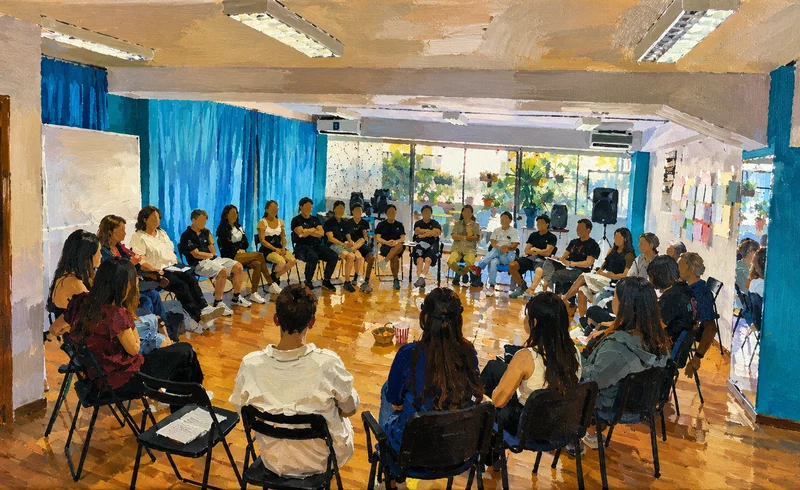
In Thessaloniki, a small group of adolescents meets regularly. Through role-play, recordings, and discussions in plenary and small groups, their views and attitudes are transformed into knowledge that can shape how the country's future judicial professionals are trained. The group bears the name its own members chose: Fighter's Voice.
By Savvas Metaxas*
Over the past two years, a distinctive group has been operating in Thessaloniki. Its members are adolescents who have come into contact with judicial or mental health services following court referrals. The group was established through a collaboration between the Youth Participation Programme (YES) and the Community Child and Adolescent Mental Health Centre of the General Hospital of Thessaloniki "G. Papanikolaou", led by child psychiatrist Evangelini (Lilian) Athanasopoulous, a member of the scientific coordinating committee of the Child & Adolescent Mental Health Initiative (CAMHI). CAMHI collaborates with the Child Mind Institute (New York) to implement the YES Programme in five cities, where its Hub Centres also operate.
The aim of this collaboration is the systematic listening and recording of adolescents' views on issues of child-friendly justice. Its creation was prompted by the training programme for students of the National School of Judicial Officers (ESDi) implemented by CAMHI, as well as the need to inform trainees about the attitudes and perceptions of children who have experienced the system first-hand — a need frequently expressed by the professionals themselves.
What is child-friendly justice?
Child-friendly justice is defined as "a justice system that guarantees respect for and effective implementation of all children's rights to the highest possible degree, taking into account their level of maturity and their needs, and ensuring their participation, understanding of procedures, respect for their privacy and the avoidance of secondary victimisation" (Committee of Ministers of the Council of Europe, 2010).
In Greece, there is an established framework that recognises and promotes its implementation, supported by scattered legislative provisions, though there is no single piece of legislation dedicated exclusively to it. In practice, the institution faces serious challenges due to a lack of staff training, infrastructure problems, and inadequate facilities for children. It is within this context that Fighter's Voice makes its distinctive contribution.
A look inside the group
The group remains small. It is coordinated by two YES Programme professionals — the sociologist and author of this article, Savvas Metaxas, and psychologist Vasiliki Vatali — while social worker Niki Rentziou from the Community Centre participates on a regular basis. Giorgos Moschos, Director of the YES Programme, and Lilian Athanasopoulous also take part in meetings in their respective roles. Meetings are held from February to May, approximately twice a month.
Like all YES Programme groups, this one has no therapeutic character. Its functioning is based on the knowledge that emerges from the children's views, rather than on bringing to the fore each member's individual experience. Discussions begin with questions such as "What do adolescents need…", "How do you think a young person is treated by a court?" or "What would a teenager do if…". Contributions remain general yet specific, and what is striking is the children's ability to move naturally between the individual and the collective.
Without being supportive in nature, participation in a group inherently carries such elements. Members are repositioned within a network of relationships and interactions that have a therapeutic dimension, while group emotional processes activate corresponding individual psychological processes. What matters most to the children appears to be the recognition that they are not alone — that there are others with shared stories, shared concerns, shared worries. And that through this interaction, they can support one another, elements which, when present together, activate therapeutic forces within the group process.
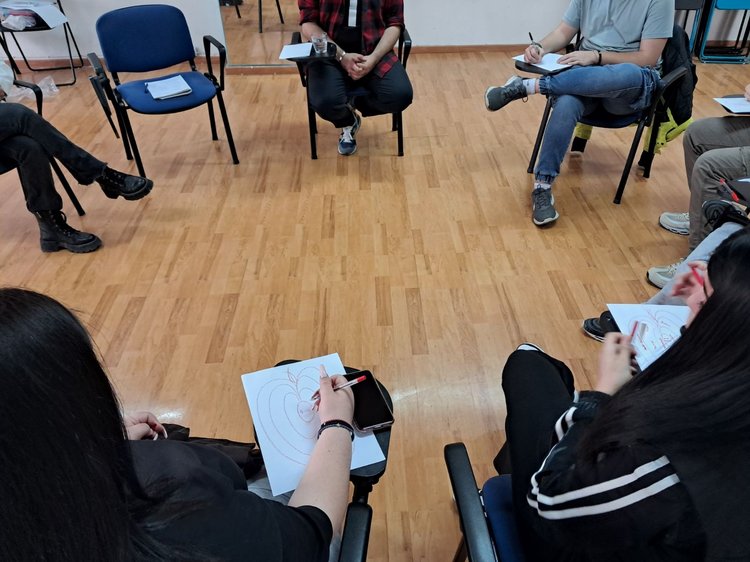
Sessions last three hours, with a significant portion devoted to play — an essential tool in an adolescent group. Play lowers defences and anxiety, strengthens cohesion, and helps young people feel accepted. On several occasions, the children's views emerged not through circle discussion but through a playful activity. Last year, during a hip-hop songwriting workshop, the children wrote: "I keep falling into the trap, I need someone to have my back", "our opinion doesn't count, and that's why we end up alone", "if you want to be a judge, you always have to be a student".
The group has also used role-play scenarios, in which members steer a fictional story towards a positive or negative outcome for the adolescent protagonist, exploring together what could have gone differently and how. The world café technique** was also used to invite the adolescents to imagine a different encounter with a judicial officer, a police officer, or a mental health professional, resulting in a significant number of proposals as well as pointed criticisms of the way the system currently operates. This year, group members took on the role of reporters and interviewed one another around a hypothetical scenario of adolescent conflict, creating an audio podcast that will soon be available.
Next steps
A few days ago, the group held a special final meeting attended not only by its regular members but also by a small number of invited young people and a group of professionals from children's justice services (a family court judge, a juvenile probation officer, a child psychiatrist, a social worker, and a juvenile police officer). The meeting included icebreaker games as well as an exchange of views on topics related to child-friendly justice. The children had prepared anonymous questions addressed to the professionals, while also having the opportunity to respond to questions from the professionals and to express, in their own words, how they imagine the services that receive minors and what they expect from each role.
One of the key objectives following the conclusion of the group's sessions is to document and make use of all the significant themes the children have raised over the past two years, with a view to producing a handbook for professionals who work with adolescents in the context of the justice system. At the same time, material from the group's sessions is already being used in CAMHI's training seminars at the NSJO, with a particularly warm response from students.
Listening to adolescents
Adolescence is in itself a period of intense change, conflict, and dreams. And all of us — young and old alike — are living through a time of rapid social and cultural transformation, where nothing seems stable and digital stimulation is constant. This is a reminder to adults who work with young people that what we once believed about adolescence may no longer hold in the same way. That is why it is so valuable to listen — systematically and actively — to what adolescents have to tell us, here and now.
What is the YES Programme
The Youth Engagement Scheme (YES) is one of the five core pillars of the Child & Adolescent Mental Health Initiative (CAMHI). It is implemented in collaboration with the Child Mind Institute (New York) and supported exclusively by the Stavros Niarchos Foundation (SNF) under the SNF Global Health Initiative. It was designed by Giorgos Moschos, YES Programme Director, lawyer, and former Deputy Ombudsman for Children's Rights, and has been in operation since 2022 through Youth Advisory Groups in Athens, Thessaloniki, Ioannina, Heraklion, and Alexandroupolis. The programme aims to ensure that adolescents' views on mental health issues that affect them are heard systematically, and that these views are incorporated into CAMHI's training programmes for adult professionals, as well as into the Programme's other deliverables. The Programme also supports teachers in implementing similar dialogue activities in their schools, thereby connecting directly with existing needs in the education system and putting forward relevant proposals.
*Savvas Metaxas is a coordinator of youth groups and educational activities, and a member of the Youth Engagement Scheme (YES) of the Child and Adolescent Mental Health Initiative (CAMHI).
**The world café is a participatory dialogue methodology used to facilitate meaningful conversations in groups. It was designed by Juanita Brown and David Isaacs in the 1990s. The core idea is that people discuss in small groups around tables, exchange ideas, and then "move" to other tables, carrying with them the knowledge and ideas that emerged.
References
-Bion, W. R. (1961). Experiences in groups and other papers. Tavistock Publications.
-Committee of Ministers of the Council of Europe. (2010). Guidelines of the Committee of Ministers of the Council of Europe on child-friendly justice. Council of Europe.
-Courakis, N. (2018). Juvenile justice in Greece: Problems in implementation and infrastructure deficiencies. University of Panteion Journal of Criminology & Criminal Justice Studies.
-European Union Agency for Fundamental Rights (FRA). (2015). Child-friendly justice — Views and experiences of professionals: Summary. Luxembourg: Publications Office of the European Union.
-Foulkes, S. H. (1964). Therapeutic group analysis. George Allen & Unwin.
-Kerig, P. K., Ford, J. D., Alexander, A. R., & Modrowski, C. A. (2024). Interventions for trauma-affected youth in the juvenile justice system: An overview of diagnostic, ethical, and clinical challenges and evidence-based treatments. Psychological Injury and Law, 17(3), 199–220. https://doi.org/10.1007/s12207-024-09497-5
-Yalom, I. D., & Leszcz, M. (2005). The theory and practice of group psychotherapy (5th ed.). New York: Basic Books.